
Aluminium, stainless steel and PVC all make a workable tile trim. The choice is not about quality — it is about where each one belongs, and what it can be finished in. We run all three, so this is a guide to choosing between them rather than a pitch for one.
The short answer
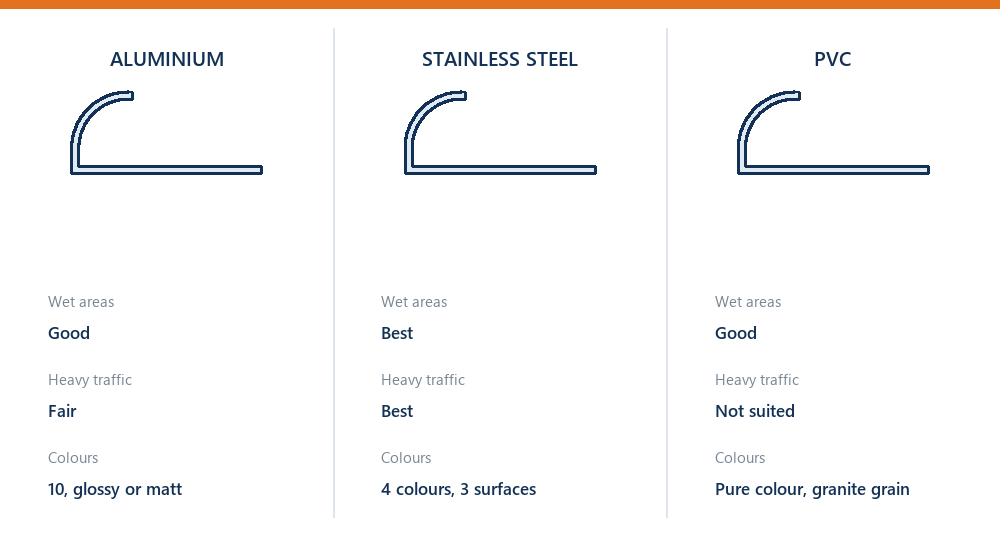
Stainless steel for wet areas and edges that get hit. Aluminium for general interior work, colour matching and custom profiles. PVC where the budget is tight and the room is dry.
Aluminium: the default for interior trim
Most interior work specifies aluminium. It is light, so a 2.5 m length handles easily on site. A custom profile is cheap to tool, which is why we run profiles to your drawing from 300 m. And it has the widest finish range: ten standard colours, each glossy or matt.
Thickness runs 0.5–1.0 mm. 0.5 mm is decorative; 1.0 mm is for where the trim takes knocks.
Stainless steel: where it earns the extra cost
Stainless earns its price in two places: areas that stay wet, and edges that get hit — a shower recess, a commercial kitchen, a hospital corridor, a stair nosing.
Four colours: silver, gold, rose gold and black. Three surfaces: mirror, matt and brushed. Mirror shows every fingerprint; brushed hides them, which is why commercial work asks for it.
The trade-offs are real: close to three times the weight of aluminium, harder to form into complex profiles, narrower colour range. Thickness 0.3–1.0 mm, most orders at 0.5–0.8 mm.
PVC: the low-cost option and where it stops
PVC wins on price and on speed. It cuts with a knife and takes adhesive, so a fitter finishes a room without a saw.
Pure colour matt or glossy — white, ivory, beige, grey and black are the common ones — plus granite grain in a wide range of stone colours, and metallic gold and silver.
Where it stops is heat: PVC softens and moves near a heat source or in sun through glass, and it will not hold a sharp shadow line.
Thickness and finish matter as much as the metal
Two trims in the same material can behave differently. On aluminium, 0.5 mm and 1.0 mm look identical on the shelf and feel different after a year of traffic.
Finish is a second decision:
- Anodised aluminium: colour in the metal, does not chip.
- Powder coated: widest range, but a chip shows bare metal.
- Brushed stainless hides scratches; mirror does not.
How to specify in four lines
- Where it goes — wet area, dry interior or heavy traffic.
- Material — aluminium, stainless steel or PVC.
- Size — H, W, T and the length.
- Quantity in metres, plus colour or surface.
A section drawing comes back within 24 hours, with tooling cost, MOQ and lead time. MOQ is 300 m per profile, and 300 m applies to each corner piece ordered alongside it.
Questions
Which material for a bathroom?
Stainless where the area stays wet. Anodised aluminium where the trim stays dry and you need a colour match.
Is PVC cheaper than aluminium?
Yes — normally the lowest cost of the three, but it will not hold a sharp edge in heat or heavy traffic.
Can I get the same colour in all three?
Not from one chart: aluminium has ten colours, stainless four, PVC pure colours and granite grain. Send the colour you are matching and we will confirm the closest option.
Send your drawing and get a quoted profile
Tell us the material, the size and the quantity. A section drawing comes back within 24 hours, with the tooling cost, the MOQ for that profile and the lead time.
Leave a Reply