Many buyers cannot tell black anodised from black powder-coated until they ask one question: does powder coating fall off more easily?
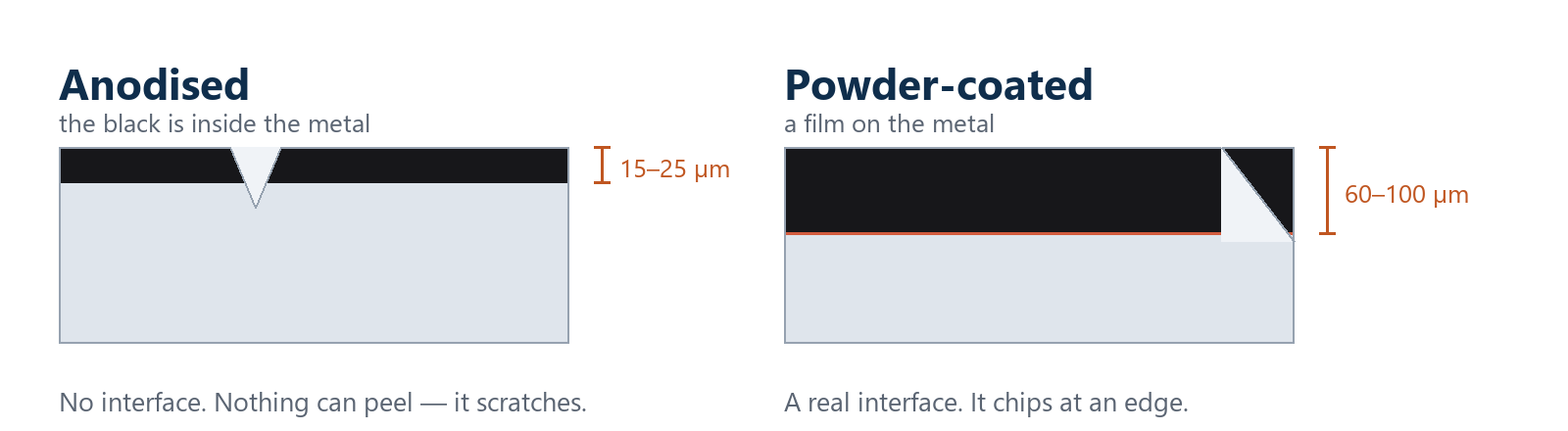
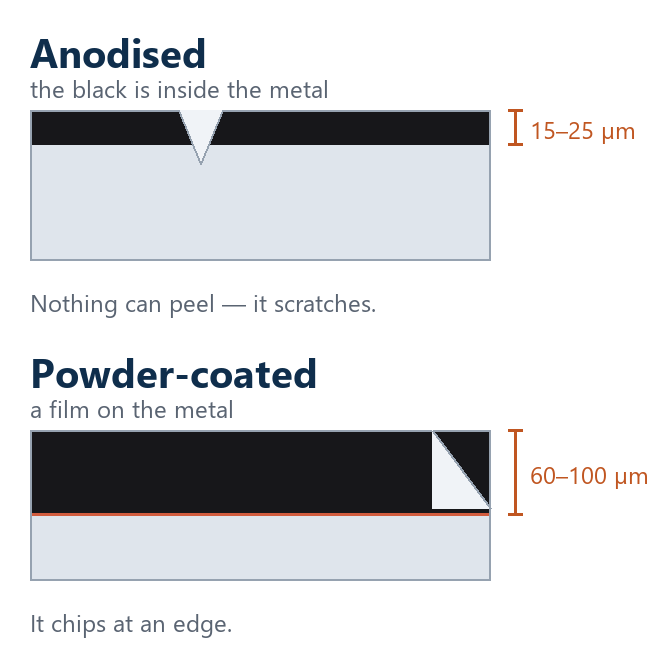
Short answer. No. Anodised black has nothing to peel — the colour is part of the metal. Powder coating is a film on top, so it can chip at an edge.
Two blacks, two different things
Anodising turns the surface of the aluminium itself into oxide. The black sits inside it, not on it.
Powder coating sprays a dry film onto the metal and cures it. The film sits on top — bonded to the metal, but a layer of its own.
So which one fails?
Anodised black does not peel; it scratches. A deep scratch shows bright metal underneath, and it cannot be repaired.
Powder chips at an edge or a fixing point. Indoors it stays a cosmetic chip, and it can be touched in.
| Black anodised | Black powder-coated | |
|---|---|---|
| Scratches | Resists wear better | Marks more easily |
| Chips | Does not chip | Can chip at edges |
| Colour | Shifts between batches | Exact RAL, repeatable |
| Tight fits | No effect | Adds film thickness |
Which one to pick
Anodised — trim handled daily, tight fits, and a metallic sheen that never looks painted.
Powder — an exact RAL or brand black, flat and matte, several colours in one order.
A straight run of skirting in a dry room? Either will outlast the building. Take the cheaper one.
Quick answers
Can a scratched anodised profile be repaired?
No. The colour is inside the metal, so there is nothing to touch in.
Does powder peel off in sheets?
Not on a properly pre-treated extrusion. It chips at edges rather than peeling away.
Does powder change how the parts fit?
Yes — the film adds thickness, which matters on a press fit. Tell us the fit and we allow for it in the drawing.
Send us a drawing and we will quote both finishes on the same profile: tile trim, skirting, wall panel trim. Lengths and lead times are on the wholesale page.
Leave a Reply